
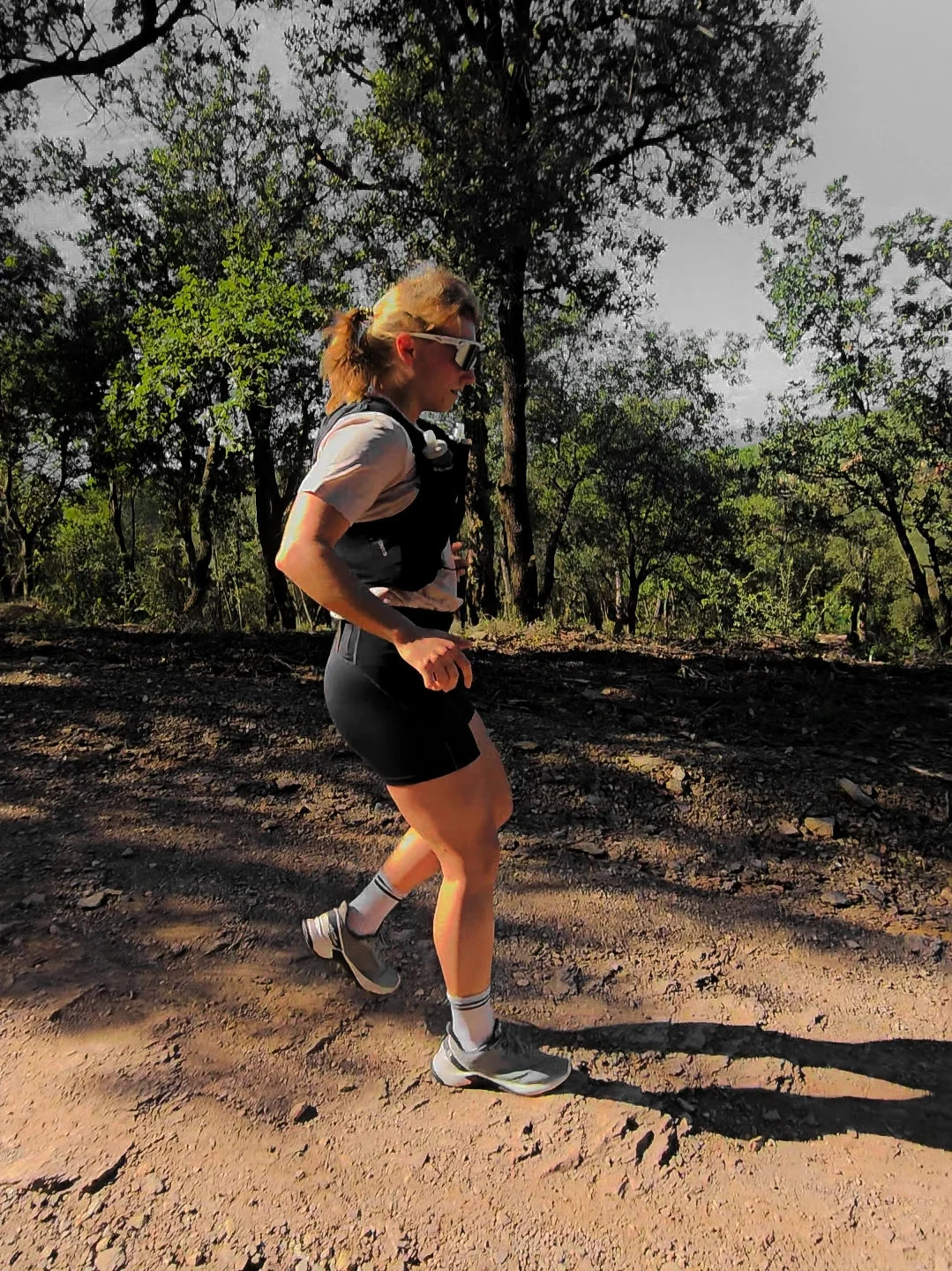
Trail Half Marathon training plan
- 12 weeks
- Running
- Duration
- 12 weeks
- Sessions
- 83 in total
- avg. 6.9 per week
- Training time
- avg. 7 h/week
- Peak week 8.8 h
- Key sessions
- 24 key sessions
Bundle offer
Save 15% with the bundle
Together with Trail Ultra, this plan costs €22.95 instead of €27.00 on its own.
View bundle Trail: from half marathon to ultraHow the training load develops
Training time per week over 12 weeks. The toughest week is week 10 with 8.8 h.
Plan structure
83 sessions spread over 12 weeks, around 84 hours of training and a total load of 4,961 TSS.
- Running 60 sessions 559.1 km in total
- Strength training 23 sessions
| Week | Sessions | Sports | Time |
|---|---|---|---|
| 1 | 7 3 Key |
|
6.4 h |
| 2 | 7 3 Key |
|
6.8 h |
| 3 | 7 1 Key |
|
5.2 h |
| 4 | 7 2 Key |
|
7.2 h |
| 5 | 7 2 Key |
|
7.8 h |
| 6 | 7 1 Key |
|
5.5 h |
| 7 | 7 2 Key |
|
8.2 h |
| 8 | 7 2 Key |
|
8.7 h |
| 9 | 7 1 Key |
|
5.9 h |
| 10 | 7 3 Key |
|
8.8 h |
| 11 | 7 3 Key |
|
7.1 h |
| 12 | 6 1 Key |
|
6.6 h |
A look inside the plan
Sample week: week 7 of 12
This is exactly how your plan will look in the Aspect App after you buy it. Tap a session to see its structure, intervals and target ranges.
Week 7 Race-Specific Phase – Load Week 1 7 sessions 8:11 h 54.6 km 2
About this training plan
This 12-week trail running plan prepares you for a trail half marathon of about 21 km and 2,000 m of climbing, with five running days a week. Flat sessions are guided by pace, everything on trails by feel. Hill training, downhill technique and long runs on a race-like profile make you strong on the climbs without your quads giving out in the second half of the race.
Who the plan is for
You have been running 40 to 55 km a week for years, have finished road half marathons or your first trail races and are familiar with intervals. 105 minutes on trails feels easy to you, because that is where the long run starts. You have access to a climb with 150 to 200 m of continuous ascent. If you already run 60 km or more a week and want to race for placings, Level 3 will challenge you more.
How the plan works
A fixed weekly rhythm: Tuesday hill training, Wednesday easy or downhill technique followed by the strength session, Friday flat and brisk, Saturday easy on trails, Sunday the long run. On Mondays you stretch, and Thursday stays free.
- Strength on the hills: One-minute hill repeats by feel and flat threshold blocks. The long run grows steadily to 115 minutes.
- Longer uphill, controlled downhill: The climbs become uphill threshold efforts of 6 and 8 minutes, on Wednesdays you learn to run downhill with control, and on Fridays the tempo run comes in.
- Race profile: The long run gets three climbs at race effort and full fuelling, just as on race day. In week 10 you run 180 minutes with 1,300 m of climbing.
- Dress rehearsal and race week: The dress rehearsal in week 11 runs just like the race, and in race week two short opener sessions keep you fresh, one of them with short climbs.
Every third week is a recovery week, with shorter runs, less climbing and only one hard session.
What you need before you start
- A recent 10 km test at full effort on a flat course, or the results of a lab performance test. Your threshold pace is roughly your 10 km pace, and every pace-based target in the flat sessions refers to it.
- A GPS running watch with pace display. You don’t need a chest strap – on trails you go by feel.
- A climb with a 6 to 12% gradient and at least 150 m of continuous ascent, plus hilly terrain for the long runs. If you don’t have a hill, the plan explains the alternatives using a treadmill and a short ramp.
- Trail shoes with grippy soles, a running vest with bottles and the fuelling you plan to use in the race.
Support within the plan
Weekly briefings explain each block and tell you where to hold back. Expert notes on kit and safety in the mountains, downhill running, fuelling and the course profile, mental coaching prompts from your first goal through to a race plan with effort levels and a timetable for each section of the course, a guide to pacing yourself on trails and a race-day checklist guide you along the way. After the race, the plan shows you how to carry on.
Which level is right for you?
- Level 2: You run 40 to 55 km a week on five days and have finished road half marathons or your first trail races. The longest run reaches 180 minutes with 1,300 m of climbing, and the peak weeks 2,480 m of climbing.
- Level 3: You run 60 to 80 km a week on six days and have several trail races behind you. The longest run reaches 180 minutes with 1,600 m of climbing and the peak weeks 3,030 m of climbing, plus flat threshold on Thursdays and climbs in the threshold zone during the long run.
If you have never run for longer than 90 minutes on trails or you run less than 40 km a week, build a base first with Half Marathon Personal Best (Level 1) and then move on to this plan.
Intensity guidance
Your training thresholds
Session intensity is based on your personal thresholds. After buying, you enter them in the Aspect App – the plan then converts every target for you.
Here’s how to find your values:
- Perceived exertion (running)You don’t need any measurements for this: intensity is given on the Borg scale from 6 (no exertion) to 20 (maximal exertion). You run by feel.
- Threshold pace (running)Your threshold pace is the pace you can sustain for about 60 minutes, roughly your 10K to half-marathon pace.Test: After a good warm-up, run on your own for 30 minutes as fast as you can hold evenly. Your average pace over the last 20 minutes is your threshold pace.
Device sync via Garmin Connect and Intervals.icu
Your plan on your watch
Send your plan directly to Garmin Connect in just a few clicks: your run sessions reach your Garmin watch or Edge as structured workouts with your target values. For COROS, Suunto and Zwift, you use your free Intervals.icu account. No retyping and no file imports.
Ready in six steps
- Buy the planOnce your payment has been received, you’ll get your access link by email.
- Save it to your Aspect accountWith a free Aspect account, you save the plan under “My plans”.
- Connect accountTap “Garmin Connect” at the top of your plan. With a Garmin watch or Edge, choose “Connect with Garmin Connect” and agree to the transfer to Garmin. For all other devices, choose “No Garmin? Connect Intervals.icu” and connect your free account on intervals.icu (opens an external site).
- Check target valuesFrom your values in the plan (e.g. FTP, threshold HR or threshold pace), the app calculates watts, heart rate and pace for Garmin. With Intervals.icu, it checks whether the same values are set there. You match any differences with one click.
- Choose a start date and sendChoose your start Monday and send.
- Connect your device (Intervals.icu only)For COROS, Suunto and Zwift, go to Settings → Connections in Intervals.icu, connect your device or platform and enable uploading planned workouts (e.g. “Upload planned workouts”).
What arrives where
| Platform | What arrives |
|---|---|
| Garmin | Directly via Garmin Connect: Running as structured workouts with your target values, strength as an exercise list (supported) |
| Suunto | Via Intervals.icu: Planned workouts (watches with SuuntoPlus Guides) (supported) |
| COROS | Via Intervals.icu: Planned workouts – the first time only, drag the “Intervals.icu” training plan into your calendar in the COROS app. (supported) |
| Zwift | Via Intervals.icu: Run workouts (supported) |
| Apple Watch | No official integration – only via third-party apps (e.g. Watchletic – the Intervals.icu import is a paid feature) (limited) |
| Polar | No direct transfer (not supported) |
Transfer details
- Garmin Connect always receives the next 14 days – more follow automatically. The complete plan is in the Aspect App.
- The Aspect App calculates the target values (watts, heart rate or pace) from your values in the plan when sending. If you change them, the upcoming workouts in Garmin Connect are updated automatically.
- If you move a session within its week in the Aspect App, it is moved in Garmin Connect too.
- Strength sessions arrive in Garmin Connect as an exercise list (e.g. “3×10 squats”). You can see the exercises in detail in the Aspect App.
- For COROS, Suunto and Zwift, you use your free Intervals.icu account: most services receive roughly the next 7 days at a time from there, and Intervals.icu calculates the target ranges from your values there.
- Zwift uses the values in your Zwift profile (FTP, 5K time). Enter the same values there as in Intervals.icu.
In the Aspect App you can also download run workouts as FIT files (e.g. for Garmin, Wahoo, COROS) or as ZWO files for Zwift.
What you get
- The complete 12-week plan83 sessions, structured week by week and day by day.
- All sessions in the Aspect AppEvery session with its full structure. In the browser on your smartphone, tablet or computer.
- Flexible within your weekIf a day doesn’t suit you, you can use a free Aspect account to move sessions to another day within the plan week or change their order – by drag & drop on a computer, or via “Move to…” on a smartphone. You can restore the original order at any time.
- Straight to your watchAs structured workouts with your target values, directly via Garmin Connect – for COROS, Suunto and Zwift via your free Intervals.icu account. Or as a FIT/ZWO download. How it works
- 24 marked key sessionsThe sessions that matter most in each week. They take priority if you need to reschedule.
- Access with or without an accountPersonal access link by email. With a free Aspect account, saved permanently under “My plans” – and ready to send to your watch.

Created by your coach
Hi, I’m Alex – coach and the mind behind aspect®. My training plans grow out of my endurance coaching work in triathlon, cycling and running. If you’d rather have individual coaching than a ready-made plan, take a look at 1:1 coaching.
Frequently asked questions
How do I get the training plan after purchase?
Once we’ve received your payment, you’ll get an email with your personal access link. Use it to open the plan directly in the Aspect App – in the browser on your smartphone, tablet or computer. You’ll also receive your invoice by email.
How does the plan get onto my watch?
Directly via Garmin Connect: open your plan in the Aspect App, tap “Garmin Connect” at the top and follow the steps in the “Plan on your watch” window: “Connect with Garmin Connect”, “Check target values” and “Send to Garmin”. The workouts reach your Garmin watch or Edge with your target values. Strength sessions arrive as an exercise list. Garmin Connect always receives the next 14 days – more follow automatically. For COROS, Suunto and Zwift, you use Intervals.icu: in the same window, choose “No Garmin? Connect Intervals.icu”, connect your free Intervals.icu account, match your target values and send the plan to your Intervals.icu calendar. There, under Settings → Connections, you connect your device or platform and enable uploading planned workouts (e.g. “Upload planned workouts”). Zwift uses the values in your Zwift profile (FTP, 5K time). Most services receive roughly the next 7 days at a time.
Does it work with the Apple Watch?
Not directly: there’s no official Intervals.icu integration for the Apple Watch. It’s only possible via third-party apps (e.g. Watchletic – the Intervals.icu import is a paid feature). Polar isn’t supported directly either. You can still see all your sessions in the Aspect App at any time – including in your smartphone’s browser.
Does Intervals.icu cost anything?
No. A free Intervals.icu account is all you need for the transfer. Intervals.icu also offers an optional supporter subscription – you don’t need it for this. Transferring from the Aspect App doesn’t cost anything extra either.
Do I have to keep my values up to date in two places?
No. For Garmin Connect, the Aspect App calculates the target values from the values in your plan when sending – if you change them, the upcoming workouts in Garmin Connect are updated automatically. If you use Intervals.icu, the “Match target values” step checks whether the same values are stored there as in your plan. If something differs, you choose which value applies and match them with one click. Nothing is overwritten without asking. Zwift still uses the values in your Zwift profile.
Do I need an account in the Aspect App?
Not to view it: the access link also works without an account. With a free Aspect account, you save the plan permanently under “My plans” – and only then can you transfer it to your watch directly via Garmin Connect or via Intervals.icu.
When can I start the plan?
Whenever you like. The plan isn’t tied to a date but built in weeks (week 1 to 12), and each week starts on a Monday. If you have a race in mind, simply count back 12 weeks from race day. For the transfer to Garmin Connect or Intervals.icu, you choose your start Monday yourself.
What happens if I start later or need to reschedule?
No problem. If you want to start the whole plan later, choose “Reschedule” in the “Plan on your watch” window and pick a new start Monday – sessions already sent are moved to the new days in Garmin Connect. With Intervals.icu, choose a new start date under “Intervals.icu” → “Reschedule” – the sessions are moved without any duplicate entries. Your own entries in Garmin Connect and Intervals.icu stay untouched. If just a single day doesn’t work, move the session within its week (see next question).
Can I move sessions to other days?
Yes, within the respective plan week. With a free Aspect account, you move a session in the plan view to another day of the same week or change the order on a day – on a computer by drag and drop, on a smartphone via the “Move to …” menu on each session. The plan itself stays unchanged: moved sessions are marked with a small icon (e.g. “originally Tuesday”), and “Reset week” or “Reset whole plan” restores the original order. If the plan has been transferred to Garmin Connect or Intervals.icu, moves and resets are applied there automatically. If you move a transferred session directly in Garmin Connect or in the Intervals.icu calendar within its week, the Aspect App picks this up (for Garmin Connect at the daily sync). If a session ends up outside its plan week, the app moves it back to its week and shows you a notice. Without an account, you can view the plan but not move sessions.
Is the plan tailored to me personally?
No – it’s a ready-made training plan that works for many athletes with a similar goal. If you’d like individual support, you’ll find 1:1 coaching at aspect-sports.com.
Do I have a right of withdrawal?
The training plan is digital content. With your express consent, it is made available before the withdrawal period has expired – your right of withdrawal then expires when provision begins (Section 356(5) of the German Civil Code, BGB). You’ll find the details in our withdrawal policy.
Trail Half Marathon (RPE)
12 weeks · 83 sessions · €27.00 (final price*)
More training plans
All plans
My First Triathlon
Goal: First triathlon finish
- Duration
- 9 weeks
- Per week
- Avg. 3.5 h · 5–9 sessions
- Guided by Bike
- Power or heart rate (your choice)
- Guided by Run
- Pace or heart rate (your choice)
- Devices
- Garmin Connect direct, Wahoo, COROS & more via Intervals.icu

Off-Season Threshold & VO2max Running
Goal: Improve threshold & VO2max
- Duration
- 12 weeks
- Per week
- Avg. 7 h · 8 sessions
- Guided by Run
- Pace or heart rate (your choice)
- Devices
- Garmin Connect direct, COROS, Suunto & more via Intervals.icu
Off-Season Threshold & VO2max Running
Goal: Improve threshold & VO2max
- Duration
- 12 weeks
- Per week
- Avg. 5.6 h · 7 sessions
- Guided by Run
- Pace or heart rate (your choice)
- Devices
- Garmin Connect direct, COROS, Suunto & more via Intervals.icu